Unit I: Price Elasticity of Demand (PED)
Price elasticity of demand, or PED, is a measure of how consumers react to a change in price. There are three types:
Elastic demand is very sensitive to changes in price. This means the product has multiple substitutes and isn't a necessity. An example is roses. If the price of roses increases, consumers will look for other cheaper flowers to buy. For this demand, E>1.
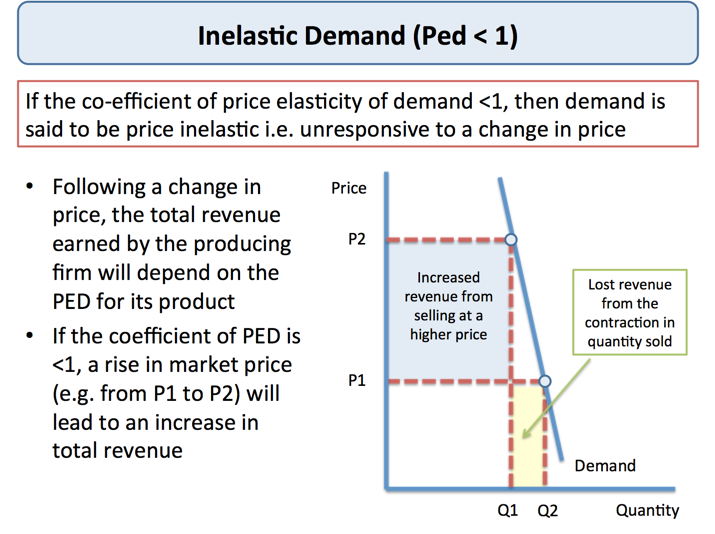
Inelastic demand isn't sensitive to changes in price. This means the product is a necessity and there are fewer or no substitutes. An example would be insulin. Some people need this to survive, so no matter if the price of it is $3 or $300, they will still buy it. For this demand, E<1.
Unitary elastic demand is where E=1.


To solve for E, there are three steps:
Elastic demand is very sensitive to changes in price. This means the product has multiple substitutes and isn't a necessity. An example is roses. If the price of roses increases, consumers will look for other cheaper flowers to buy. For this demand, E>1.
Inelastic demand isn't sensitive to changes in price. This means the product is a necessity and there are fewer or no substitutes. An example would be insulin. Some people need this to survive, so no matter if the price of it is $3 or $300, they will still buy it. For this demand, E<1.
Unitary elastic demand is where E=1.
To solve for E, there are three steps:
- Find the percentage Δ in quantity using the formula (new quantity - old quantity)/old quantity
- Find the percentage Δ in price using the formula (new price - old price)/old price
- Solve for E by using the formula (percentage Δ in quantity)/(percentage Δ in price)
Things to note:
- If a value comes out negative, take its absolute value
- Take only the first two numbers after the decimal if needed (no rounding)
For more information, refer to this page from tutor2u's website:

Comments
Post a Comment