Unit III: The AS/AD Model
The AS/AD model shows that the equilibrium of AS and AD determines the current output (real GDP) and the price level.
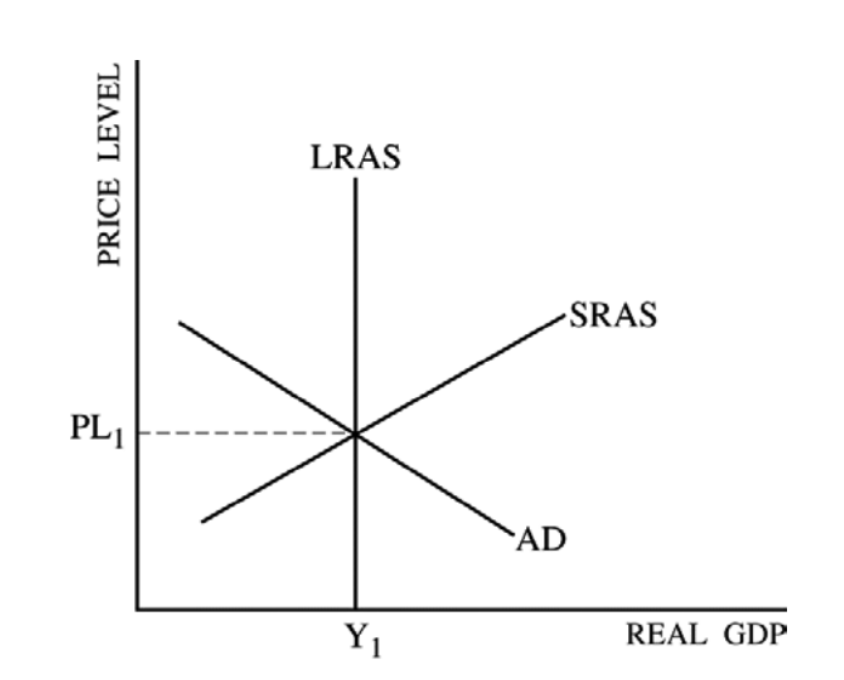
Full employment equilibrium exists where AD intersects SRAS and LRAS at the same point.

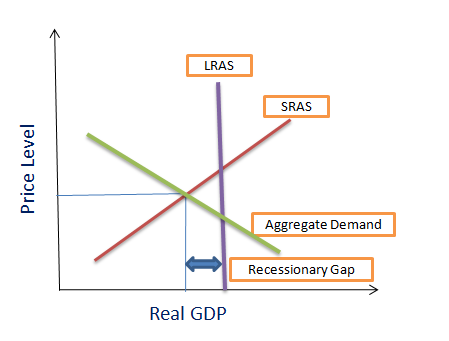
A recessionary gap exists when equilibrium occurs below full-employment output
An inflationary gap exists when equilibrium occurs beyond full employment output.


Full employment equilibrium exists where AD intersects SRAS and LRAS at the same point.
A recessionary gap exists when equilibrium occurs below full-employment output
- AD <-
- SRAS <-
An inflationary gap exists when equilibrium occurs beyond full employment output.
- AD ->
- SRAS ->
There are three ranges of SRAS: Keynesian or horizontal range, intermediate range, and classical or vertical range.
Keynesian or horizontal range occurs when we are in a recession or depression, not fully using all of our resources, and below full employment.
Intermediate-range occurs when resources are getting closer to full employment levels, which creates upward pressure on wages and prices.
Classical or vertical range occurs when real GDP is at a level below the full employment level where any increase in demand will result only in an increase in prices.
Demand-pull inflation is an increase in the average price level resulting from an increase in total spending in the economy. C, I, G, and X make the AD in a nation. AD always increases.
Cost-push inflation is when firms respond to rising costs by increasing their prices to protect profit margins. It can be caused by the following:
- Rising unit labor costs
- An increase in the price of raw materials
- A depreciation in the exchange rate causing a rise in import costs
- An increase in business taxes, for example, a value-added tax (VAT) or environmental taxes such as a carbon tax
- Expectations in the inflation rate
Some factors affecting inflationary pressures are as follows:
- Rising property prices -> increased consumer wealth -> demand-pull inflation risk
- Increasing world oil prices -> higher costs for businesses -> cost-push inflation risk
- Depreciating exchange rate -> increased import prices and rising exports -> cost-push and demand-pull inflation risk
- The rapid expansion of money and credit from banks -> rising consumer spending financed by loans -> demand-pull inflation risk
For more information, please refer to these videos on Khan Academy:
Short-run and long-run equilibrium and the business cycle: https://www.khanacademy.org/economics-finance-domain/ap-macroeconomics/national-income-and-price-determinations/equilibrium-in-the-ad-as-model-ap/v/short-run-and-long-run-equilibrium-and-the-business-cycle-ap-macroeconomics-khan-academy?modal=1
Demand-pull inflation under Johnson: https://www.khanacademy.org/economics-finance-domain/ap-macroeconomics/national-income-and-price-determinations/changes-in-the-ad-as-model-in-the-short-run-ap/v/demand-pull-inflation-under-johnson?modal=1
Cost-push inflation: https://www.khanacademy.org/economics-finance-domain/ap-macroeconomics/national-income-and-price-determinations/changes-in-the-ad-as-model-in-the-short-run-ap/v/cost-push-inflation?modal=1

Comments
Post a Comment