Unit VII: The Balance of Payments
The balance of payments is the measure of money inflows and outflows between the United States and the Rest of the World (ROW). Inflows are referred to as credits and outflows are referred to as debits. The balance of payments is divided into three accounts: current account, capital/financial account, and official reserves account.
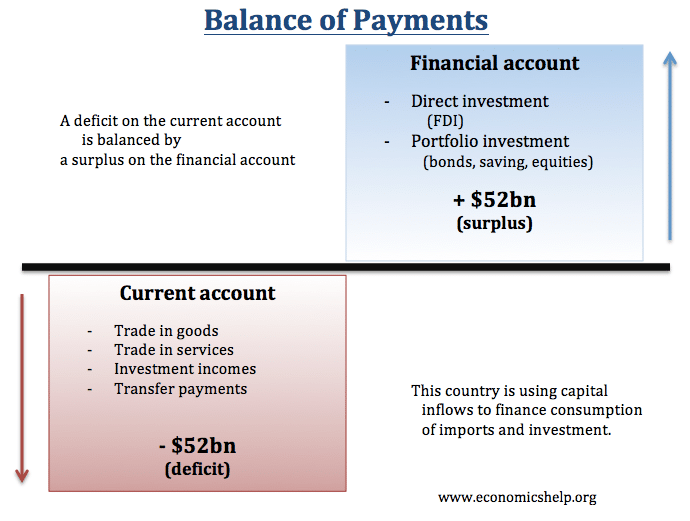
Current Account
- Balance of trade or net exports
- exports of goods/services - import of goods/services
- exports create a credit to the balance of payments
- imports create a debit to the balance of payments
- Net foreign income
- income earned by U.S. owned foreign assets - income paid to foreign-held U.S. assets
- ex: interest payments on U.S. owned Brazilian bonds - interest payments on German-owned U.S. Treasury bonds
- Net transfers (tend to be unilateral)
- foreign aid -> a debit to the current account
- ex: Mexican migrant workers send money to family in Mexico
Capital/Financial Account
- The balance of capital ownership
- Includes the purchase of both real and financial assets
- Direct investment in the U.S. is a credit to the capital account
- ex: the Toyota Factory in San Antonio
- Direct investment by U.S. firms/individuals in a foreign country are debits to the capital account
- ex: the Intel Factory in San Jose, Costa Rica
- Purchase of foreign financial assets represents a debit to the capital account
- ex: Warren Buffet buys stock in Petrochina
- Purchase of domestic financial assets by foreigners represents a credit to the capital account
- ex: the U.A.E. sovereign wealth fund purchases a large stake in the NASDAQ
Relationship between Current and Capital Amount
- Remember double-entry bookkeeping?
- the current account and the capital account should zero each other out

Official Reserves
- The foreign currency holding of the United States Federal Reserve System
- When there is a balance of payments surplus, the Fed accumulates foreign currency and debits the balance of payments
- When there is a balance of payments deficit, the Fed depletes its reserves of foreign currency and credits the balance of payments
- The official reserves zero out the balance of payments
- That is if one account has a negative balance (deficit), the other must have a positive balance (surplus)

For more information, please refer to these videos on Khan Academy:
Balance of payments: Current account: https://www.khanacademy.org/economics-finance-domain/ap-macroeconomics/ap-open-economy-international-trade-and-finance/the-balance-of-payments/v/balance-of-payments-current-account?modal=1
Data on Chinese US balance of payments: https://www.khanacademy.org/economics-finance-domain/ap-macroeconomics/ap-open-economy-international-trade-and-finance/the-balance-of-payments/v/data-on-chinese-us-balance-of-payments?modal=1

I like that the balance of payments deficit and surplus is self explanatory based on the terms used. I also find it interesting that during a deficit the fed will deplete its reserves of foreign currency which may seem counter intuitive but actually helps.
ReplyDelete